
Results after 1 prior treatment

JIDEYTRO showed results for people who had previously received only 1 prior ROS1-targeted therapy
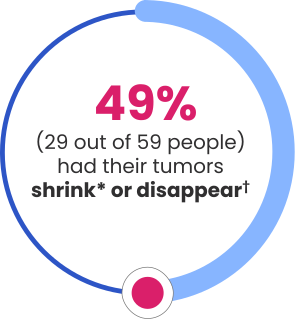
For people whose second therapy was JIDEYTRO
49% overall response rate
Duration of response

86% of people who responded
to treatment (25 out of 29) had results that lasted at least 12 months
Limitations of exploratory findings
Some study results, including the results above, are called exploratory. Exploratory findings look at additional questions beyond the main study goals. Because the results are from a small number of people, they should be interpreted carefully. These results may not reflect everyone’s experience.
Of the 117 people in the study, half (50%) had received 1 prior ROS1-targeted therapy (crizotinib, entrectinib, repotrectinib, or taletrectinib).
*At least a 30% decrease as measured by Response Evaluation Criteria in Solid Tumors (RECIST) during 2 different tumor evaluations. RECIST is a standard way to measure how well a patient responds to treatment. It is based on whether tumors shrink, stay the same, get bigger, or spread to a new part of the body.
†A complete response (tumor disappearing) does not mean the cancer has been cured.
Individual treatment results may vary. Talk to your doctor to see if JIDEYTRO may be right for you.

Keep track of any side effects and discuss them with your care team.
Understanding the different ways results are measured
What is overall response rate?
The proportion of people who saw their tumors shrink by at least 30%* or disappear during treatment and follow-up in the clinical study. This includes both partial response and complete response.
What is partial response?
The cancer has shrunk by at least 30%,* and there are no signs that the cancer has grown anywhere else in the body.
What is complete response?
When signs of a tumor have completely disappeared with no evidence of disease visible on scans or other tests. This does not mean the cancer has been cured.
If cancer is in the brain, the results are measured by intracranial overall response rate, intracranial partial response, and intracranial complete response.
What is duration of response?
The length of time that a person keeps living without their cancer progressing, after seeing a complete response or partial response.
*At least a 30% decrease as measured by Response Evaluation Criteria in Solid Tumors (RECIST) during 2 different tumor evaluations. RECIST is a standard way to measure how well a patient responds to treatment. It is based on whether tumors shrink, stay the same, get bigger, or spread to a new part of the body.

Learn more about how JIDEYTRO was studied to treat advanced ROS1+ NSCLC.
How to take JIDEYTRO
Learn about taking once-daily JIDEYTRO, a medication that can coexist with your routine.
Download JIDEYTRO resources
Explore educational resources as you consider next steps.
NSCLC=non-small cell lung cancer; ROS1+=ROS proto-oncogene 1-positive.